
Electron Configuration Worksheet PDF with Answers: A Comprehensive Plan
Electron configuration worksheets‚ often available as PDF files‚ are crucial tools for mastering chemistry concepts. These resources present practice problems‚ aiding in understanding and applying the rules of electron configurations.
They frequently include tasks like identifying correct/incorrect configurations‚ determining elements from their configurations‚ and writing configurations for ions – like Ti4 achieving a noble gas configuration.
Students can find these worksheets online‚ alongside answer keys‚ to self-assess and reinforce their learning‚ avoiding common mistakes in the process.
Electron configuration is the foundation for understanding atomic behavior and chemical bonding. It details how electrons are arranged within an atom’s energy levels and orbitals‚ dictating its properties and reactivity. Mastering this concept is vital in chemistry‚ and electron configuration worksheets – frequently found as PDF documents – provide invaluable practice.
These worksheets aren’t simply about memorization; they encourage a deeper comprehension of the principles governing electron arrangement. They often present scenarios requiring students to apply the Aufbau principle‚ Hund’s rule‚ and the Pauli exclusion principle.
Successfully navigating these practice problems builds a strong base for predicting chemical reactions and interpreting the periodic table. The availability of answer keys allows for independent learning and error correction‚ solidifying understanding and preparing students for more advanced topics.
What is Electron Configuration?
Electron configuration is a specific depiction of how electrons are distributed among the various atomic orbitals within an atom. It’s essentially a ‘map’ showing which orbitals contain electrons and how many electrons occupy each. This arrangement isn’t random; it follows strict rules based on quantum mechanics;
Represented using notations like 1s22s22p6‚ it details the principal energy level (1‚ 2‚ 3…)‚ sublevel (s‚ p‚ d‚ f)‚ and the number of electrons in each sublevel. Understanding this notation is key to utilizing electron configuration worksheets‚ often available as PDFs.
These worksheets challenge students to predict and verify configurations‚ reinforcing the connection between atomic structure and chemical behavior. Correctly determining configurations is crucial for predicting an element’s properties and its interactions with others‚ making these practice problems essential.
Why are Electron Configuration Worksheets Important?
Electron configuration worksheets‚ frequently found as PDF documents‚ are vital for solidifying understanding of atomic structure and its implications. They move learning beyond memorization‚ demanding application of the Aufbau principle‚ Hund’s rule‚ and the Pauli exclusion principle.
These resources provide targeted practice in predicting electron arrangements‚ identifying errors in given configurations‚ and determining elements based on their electronic structure. Working through these problems builds a strong foundation for more advanced chemistry topics like bonding and reactivity.
Furthermore‚ the availability of answer keys allows for self-assessment and immediate feedback‚ crucial for independent learning. Mastering electron configurations through consistent practice with these worksheets is essential for success in chemistry.

Understanding the Basics
Grasping atomic number‚ orbitals‚ and energy levels is fundamental. Worksheets reinforce these concepts‚ preparing students to apply rules for filling electron configurations effectively.
Atomic Number and Mass Number
Atomic number defines the element‚ representing the number of protons within an atom’s nucleus; this dictates the number of electrons in a neutral atom‚ crucial for electron configuration. Worksheets emphasize this connection‚ requiring students to correlate atomic number with electron arrangement.
Mass number‚ conversely‚ is the sum of protons and neutrons. While not directly used in writing electron configurations‚ understanding it helps determine the number of neutrons and provides a complete picture of the atom’s composition.
Electron configuration worksheets often present exercises where students must deduce the number of protons‚ neutrons‚ and electrons given either the atomic number or mass number‚ solidifying their grasp of these foundational concepts. Correctly identifying these values is the first step towards accurately predicting an element’s electronic structure.
Orbitals and Energy Levels

Electron configuration is fundamentally about filling atomic orbitals‚ which are regions of space where electrons are most likely to be found. These orbitals exist within distinct energy levels‚ often denoted by principal quantum numbers (n=1‚ 2‚ 3‚ etc.).
Worksheets frequently require students to identify the different types of orbitals (s‚ p‚ d‚ f) and their shapes‚ alongside understanding their relative energies. For example‚ a 3p orbital is higher in energy than a 2p orbital.
Electron configuration practice often involves diagrams where students fill in orbital boxes with arrows representing electrons‚ reinforcing the concept of orbital occupancy. PDF worksheets provide visual aids and structured exercises to master this crucial aspect of atomic structure.

The Aufbau Principle
The Aufbau principle dictates the order in which electrons fill atomic orbitals. It states that electrons first occupy the lowest energy orbitals available before moving to higher energy levels. Electron configuration worksheets heavily emphasize applying this principle.
Students practicing with PDF resources learn to follow the diagonal rule‚ predicting the filling order (1s‚ 2s‚ 2p‚ 3s‚ 3p‚ 4s‚ 3d‚ etc.). Practice problems often present elements and ask students to determine their electron configurations based on this rule.
Understanding the Aufbau principle is vital for correctly predicting electron arrangements. Worksheets frequently include exercises where students identify errors in configurations that violate this fundamental rule‚ solidifying their comprehension.
Hund’s Rule
Hund’s Rule governs the filling of orbitals within a subshell. It states that electrons individually occupy each orbital within a subshell before any orbital receives a second electron‚ and these single electrons must have parallel spins. Electron configuration worksheet exercises frequently test this concept.
PDF worksheets often present scenarios requiring students to distribute electrons across p‚ d‚ or f orbitals‚ ensuring they adhere to Hund’s Rule. Practice problems might ask students to illustrate orbital diagrams‚ demonstrating the maximum multiplicity (unpaired electrons) within a subshell.
Incorrectly applying Hund’s Rule leads to unstable configurations. Worksheets help students identify these errors‚ reinforcing the importance of maximizing unpaired electrons before pairing them within the same orbital.
Pauli Exclusion Principle
The Pauli Exclusion Principle is fundamental to understanding electron configurations. It dictates that no two electrons in an atom can have the same set of four quantum numbers. This means each orbital can hold a maximum of two electrons‚ and these electrons must have opposite spins.
Electron configuration worksheet PDFs commonly assess comprehension of this principle through various practice problems. Students are often asked to determine if a given configuration violates the Pauli Exclusion Principle‚ or to correctly assign spin quantum numbers (+1/2 or -1/2) to electrons within orbitals.
Violating this principle results in an invalid configuration. Worksheets help students recognize and correct such errors‚ solidifying their understanding of the principle’s role in determining atomic structure and stability.

Writing Electron Configurations
Electron configuration worksheets‚ often in PDF format‚ guide students in writing both full and abbreviated configurations for elements and ions‚ using practice problems.
Full vs. Abbreviated Electron Configurations
Electron configuration worksheets frequently emphasize the distinction between full and abbreviated notations. A full electron configuration details all electron levels and sublevels‚ like 1s22s22p63s23p64s23d104p6. This method‚ while thorough‚ can become lengthy for larger atoms.
Abbreviated electron configurations offer a more concise representation. They utilize the preceding noble gas core‚ followed by only the valence electrons. For example‚ cobalt (Co) can be written as [Ar]3d74s2‚ significantly shortening the notation.
PDF worksheets provide practice in converting between these formats‚ reinforcing understanding. Mastering both is vital; full configurations illustrate electron distribution‚ while abbreviated forms streamline complex notations. Correctly applying these skills is often tested through problems on these worksheets.
Examples of Electron Configurations for Common Elements
Electron configuration worksheets often include examples for frequently encountered elements. Hydrogen (H) is simply 1s1‚ while Helium (He) achieves stability with 1s2. Lithium (Li) follows as 1s22s1‚ and Beryllium (Be) is 1s22s2.
Moving further‚ Nitrogen (N) is 1s22s22p3‚ Oxygen (O) is 1s22s22p4‚ and Fluorine (F) is 1s22s22p5. Neon (Ne)‚ a noble gas‚ completes the second shell with 1s22s22p6.
PDF resources demonstrate these‚ and often include examples like Argon ([Ar])‚ Cobalt ([Ar]3d74s2)‚ Silver ([Kr]4d105s1)‚ Tellurium ([Kr]4d105s25p4)‚ and Iodine ([Kr]4d105s25p5). These examples‚ presented in practice problems‚ solidify understanding and build confidence in writing configurations.
Electron Configurations of Ions
Electron configuration worksheets frequently test understanding of ion formation. When an atom loses electrons to form a cation‚ those electrons are removed from the highest energy level first. For example‚ Titanium (Ti) losing four electrons becomes Ti4+‚ achieving the electron configuration of Argon ([Ar]).
Conversely‚ anions gain electrons to fill their outermost shells. PDF resources provide practice problems involving both cations and anions. Students learn to adjust configurations accordingly‚ understanding that electron removal/addition impacts orbital filling.
Worksheets often ask students to write configurations for ions like Na+ (1s22s22p6)‚ Cl– (1s22s22p63s23p6)‚ and O2- (1s22s22p6). Mastering this skill is crucial‚ and answer keys help verify correct application of the rules.

Practice Problems & Worksheets
Electron configuration worksheets‚ often in PDF format‚ offer diverse practice problems. These include identifying errors‚ determining elements‚ and writing configurations – essential for mastery.
Types of Problems Found in Electron Configuration Worksheets
Electron configuration worksheets‚ commonly found as PDF documents‚ present a variety of challenges designed to solidify understanding. A frequent task involves verifying the correctness of given electron configurations; students must apply rules like the Aufbau principle and Hund’s rule to identify inaccuracies‚ such as an incorrect number of electrons or improper orbital filling.

Another common problem type requires students to deduce the element based solely on its electron configuration. Conversely‚ worksheets also ask students to write the full or abbreviated configuration for a given element. A significant focus lies on ion configurations‚ demanding students account for gained or lost electrons.
Furthermore‚ some worksheets present scenarios involving successive ionization energies‚ linking them back to electron configuration and orbital stability. Students may also be asked to explain their problem-solving methods‚ demonstrating a conceptual grasp beyond mere calculation. These diverse practice problems build a robust understanding of atomic structure.
Identifying Incorrect Electron Configurations
A core skill developed through electron configuration worksheets is the ability to pinpoint errors in provided configurations. These PDF-based exercises often present configurations that violate fundamental rules. Students must meticulously check for an incorrect total number of electrons‚ ensuring it matches the atomic number of the element.
Violations of the Aufbau principle – filling orbitals out of order – are common errors to identify. Similarly‚ incorrect application of Hund’s rule‚ leading to paired electrons in degenerate orbitals before complete filling‚ is frequently tested. The Pauli Exclusion Principle‚ limiting each orbital to two electrons with opposite spins‚ is another critical check.
For example‚ a configuration like 1s22s22p63s3 would be flagged as incorrect. Recognizing these errors requires a strong understanding of orbital filling order and the principles governing electron configuration. Careful analysis and application of these rules are key to success.
Determining Element from Electron Configuration
Electron configuration worksheets‚ frequently available as PDFs‚ challenge students to reverse the process – identifying the element based solely on its electron configuration. This skill reinforces understanding of the relationship between electronic structure and the periodic table.
The primary method involves summing the number of electrons in the configuration. This total directly corresponds to the element’s atomic number. Students then locate the element on the periodic table with that atomic number.
Worksheets often present both full and abbreviated configurations‚ requiring students to decipher the notation. Recognizing the final electron added is also helpful‚ as it indicates the element’s position within a period. For instance‚ a configuration ending in 4p3 suggests an element in the p-block of the fourth period. Mastering this skill solidifies the connection between electron configurations and elemental identity.
Writing Configurations for Ions – Practice
Electron configuration worksheets‚ often in PDF format‚ dedicate significant practice to writing configurations for ions. This builds upon the foundation of neutral atom configurations‚ requiring students to account for gained or lost electrons.
For cations (positive ions)‚ electrons are removed from the outermost shell first – typically the highest principal energy level (n) and then the highest angular momentum (l) sublevel. Anions (negative ions) gain electrons‚ filling orbitals according to the Aufbau principle and Hund’s rule.
Worksheets present various ions‚ like Ti4+ achieving a noble gas configuration through electron removal. Students must correctly apply these rules‚ demonstrating understanding of how ionic charge affects electronic structure. Correctly predicting the configuration for ions is vital for understanding chemical bonding and reactivity.

Advanced Concepts & Applications
Electron configuration knowledge extends to understanding periodic trends‚ isoelectronic species‚ and ionization energies. Worksheet PDFs aid in applying these concepts to complex chemical problems.
Electron Configuration and the Periodic Table
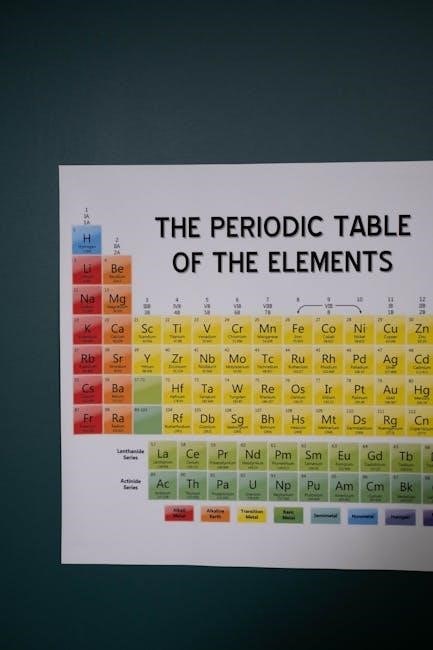
Electron configurations directly correlate with an element’s position on the periodic table. The periodic table’s structure reflects the filling of atomic orbitals‚ and understanding this relationship is vital. Worksheet PDFs often present exercises where students deduce an element’s identity based on its electron configuration‚ or conversely‚ predict the configuration given the element’s symbol.
For instance‚ elements in the same group (vertical column) share similar valence electron configurations‚ leading to comparable chemical properties. Practice problems within these worksheets challenge students to identify these patterns. Furthermore‚ the ability to relate configurations to the table helps predict an element’s reactivity and bonding behavior. Mastering this connection‚ through consistent practice using PDF resources‚ is fundamental to grasping core chemistry principles.
Analyzing configurations also reveals trends in ionization energy and electronegativity‚ further solidifying the link between electronic structure and periodic properties.
Isoelectronic Species
Isoelectronic species are ions or atoms possessing the same number of electrons. Electron configuration worksheets‚ particularly those in PDF format‚ frequently include exercises focused on identifying and comparing these species. Understanding isoelectronic species is crucial because they exhibit similar sizes and‚ consequently‚ comparable chemical properties.
Practice problems often involve determining the electron configurations of different ions and then identifying which ones are isoelectronic. For example‚ Na+‚ Ne‚ and Mg2+ all have 10 electrons and share the same configuration (1s22s22p6).
These worksheets help students move beyond simply writing configurations to applying that knowledge in a comparative context. Recognizing isoelectronic species aids in predicting reactivity and understanding the behavior of ions in solution‚ reinforcing core chemical concepts through targeted practice and readily available answer keys.
Successive Ionization Energies & Electron Configuration
Electron configuration worksheets‚ often found as PDFs‚ connect to the concept of successive ionization energies. These energies reveal how tightly electrons are held within an atom‚ directly reflecting its electron configuration. Removing successive electrons requires increasingly more energy because of increasing effective nuclear charge.

Practice problems frequently ask students to analyze ionization energy data to deduce the valence electron configuration of an element. A significant jump in ionization energy indicates the removal of a core electron‚ shielded by inner shells.
Understanding this relationship allows students to predict the number of valence electrons and the element’s group in the periodic table. Worksheets with answer keys provide valuable practice in interpreting ionization energy trends and relating them back to the fundamental principles of electron configurations‚ solidifying a deeper understanding of atomic structure.

Resources & Answers
Numerous electron configuration worksheet PDFs are freely available online‚ often including answer keys for self-assessment. Careful review avoids common errors in practice problems!
Finding Electron Configuration Worksheet PDFs
Locating suitable electron configuration worksheet PDFs is surprisingly straightforward. A quick internet search using keywords like “electron configuration practice worksheet PDF” yields a wealth of results. Many educational websites‚ including those associated with universities and online academies like Liberty University Online Academy‚ offer downloadable resources.
Chemistry-focused platforms and teacher resource sites are also excellent sources. Websites dedicated to chemistry education frequently compile lists of free worksheets. Look for PDFs that clearly state their content – focusing on writing configurations‚ identifying errors‚ or determining elements. Remember to preview the worksheet to ensure it aligns with the specific concepts you’re studying. Some PDFs are part of larger chemistry workbooks‚ while others are standalone practice sheets. Always prioritize resources from reputable sources to ensure accuracy and quality.
Where to Find Answer Keys
Securing answer keys for electron configuration worksheets is vital for effective self-study. Often‚ the website hosting the PDF worksheet will also provide a separate answer key document. Look for links labeled “Answer Key‚” “Solutions‚” or similar terms on the same webpage.
If a direct answer key isn’t available‚ searching online using the worksheet’s title or a unique problem identifier can sometimes uncover solutions posted by educators or students. Chemistry forums and online learning communities are also valuable resources where users frequently share answer keys. Be cautious when using solutions from unverified sources; cross-reference with your understanding of the concepts. Some worksheets are designed for classroom use‚ and answer keys may only be accessible to teachers.
Common Mistakes to Avoid
When tackling electron configuration worksheets‚ several common errors frequently occur. A primary mistake is incorrectly applying the Aufbau principle or Hund’s rule‚ leading to improper orbital filling. Forgetting to account for ion charges – adding or removing electrons – is another frequent issue‚ especially when writing configurations for ions.
Students often misinterpret the notation for electron configurations‚ confusing sublevels or incorrectly representing the number of electrons. Failing to recognize that electron configurations relate to the periodic table’s structure is also a pitfall. Always double-check your work‚ ensuring the total number of electrons matches the atomic number or ion charge. Carefully review the rules and practice consistently to minimize these errors.